
Fractune FIELD INSTRUMENT FOR iOS

Some buildings
feel right.
Now you can
measure why.

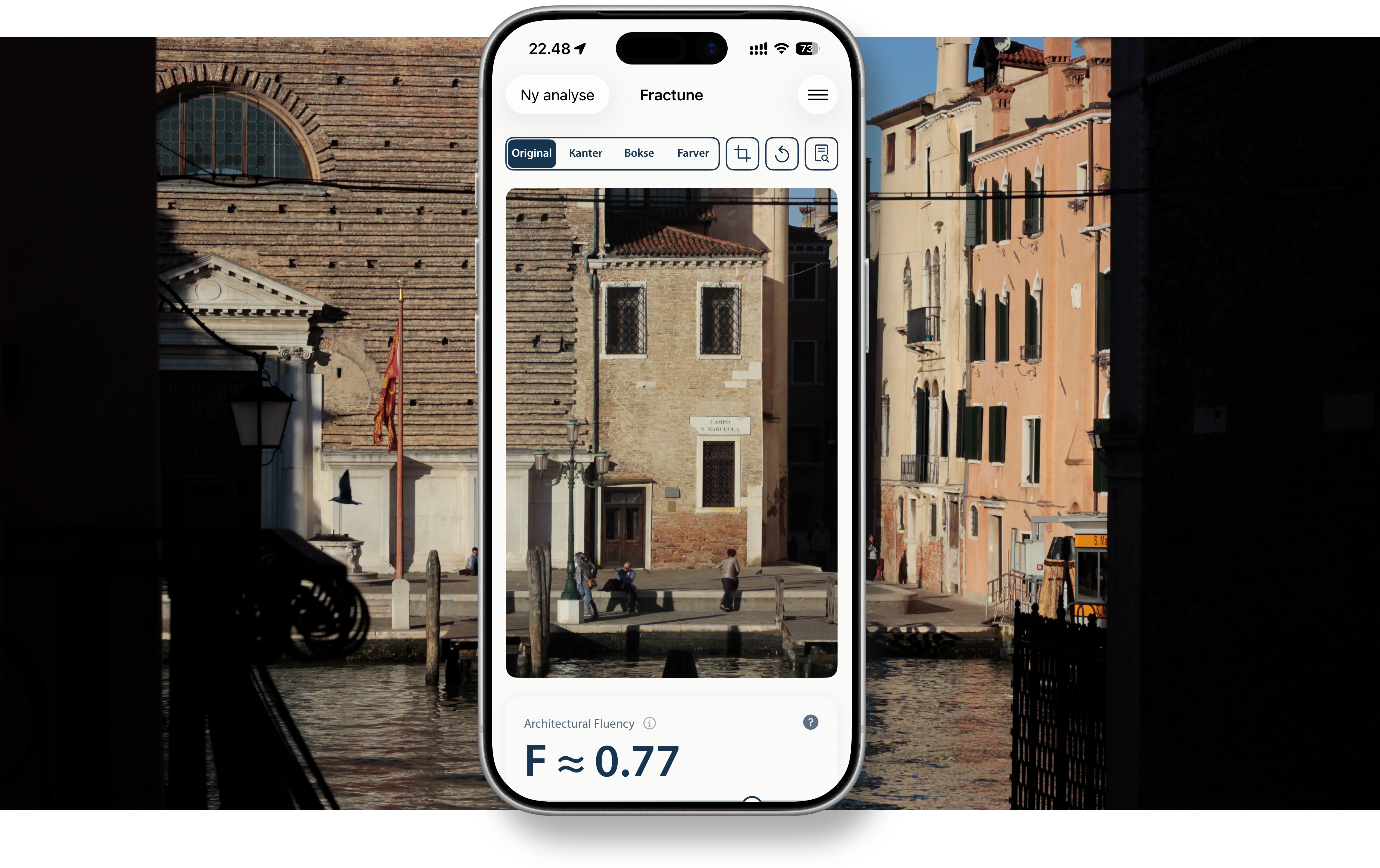
Brick facade in Venice with Fractune showing F ≈ 0.77 for the facade
SPECIMEN · SS-047
Campo San Marziale
Venezia, IT · 2025.09
PL. 01 · BRICK FACADE · VENEZIA · F · N = 85 REFERENCE PHOTO · FRACTUNE FIELD ARCHIVE

Fractune is a pocket-sized field instrument for reading the architectural fluency of building facades. Point, scan, and quantify the visual coherence a building places into the world, across four dimensions: fractal complexity, rhythm, colour, and structure.

Download on the App Store
REQ · IPHONE 14 OR LATER · iOS 26.4+
F
Headline metric
4
Dimensions
85
References
0
Images leave device

A composite reading made from four independent measurements.

F is calibrated against six decades of empirical aesthetics research. Stamps' regression coefficient β = 0.72 for surface complexity, Spehar & Taylor's 1/f1.2 preference peak, Stanischewski et al.'s edge-orientation entropy, all converge on a sweet zone where well-composed facades cluster.

The composition matters. A tile roof scores high on fractal dimension D alone, but its monotonous repetition fails on lacunarity Λ and edge-orientation entropy Hθ. F catches this, the four dimensions correct each other.

FIG. 01 · ARCHITECTURAL FLUENCY SCALE n = 85 reference buildings
MONOTONE SWEET SPOT NEAR CHAOS
0.0 0.55 0.75 1.0
Plain glass wall Fluent · Coherent · Beloved buildings Visually overwhelming
F · ICONIC MEAN
SWEET SPOT · F = 0.55 – 0.75

Where well-composed facades land. Renaissance palazzi, modernist Nordic vernacular, Belle Époque streets, different traditions, similar F.

FRACTAL SUB-DIMENSION · D = 1.41

The Ostwald & Vaughan mean across 85 canonical buildings. D is now one of four sub-scores feeding F, modulated by lacunarity Λ and edge-orientation entropy Hθ.
Point. Scan. Understand.

Every step runs on the iPhone. No image leaves the device unless you choose to contribute the reading to the open dataset.

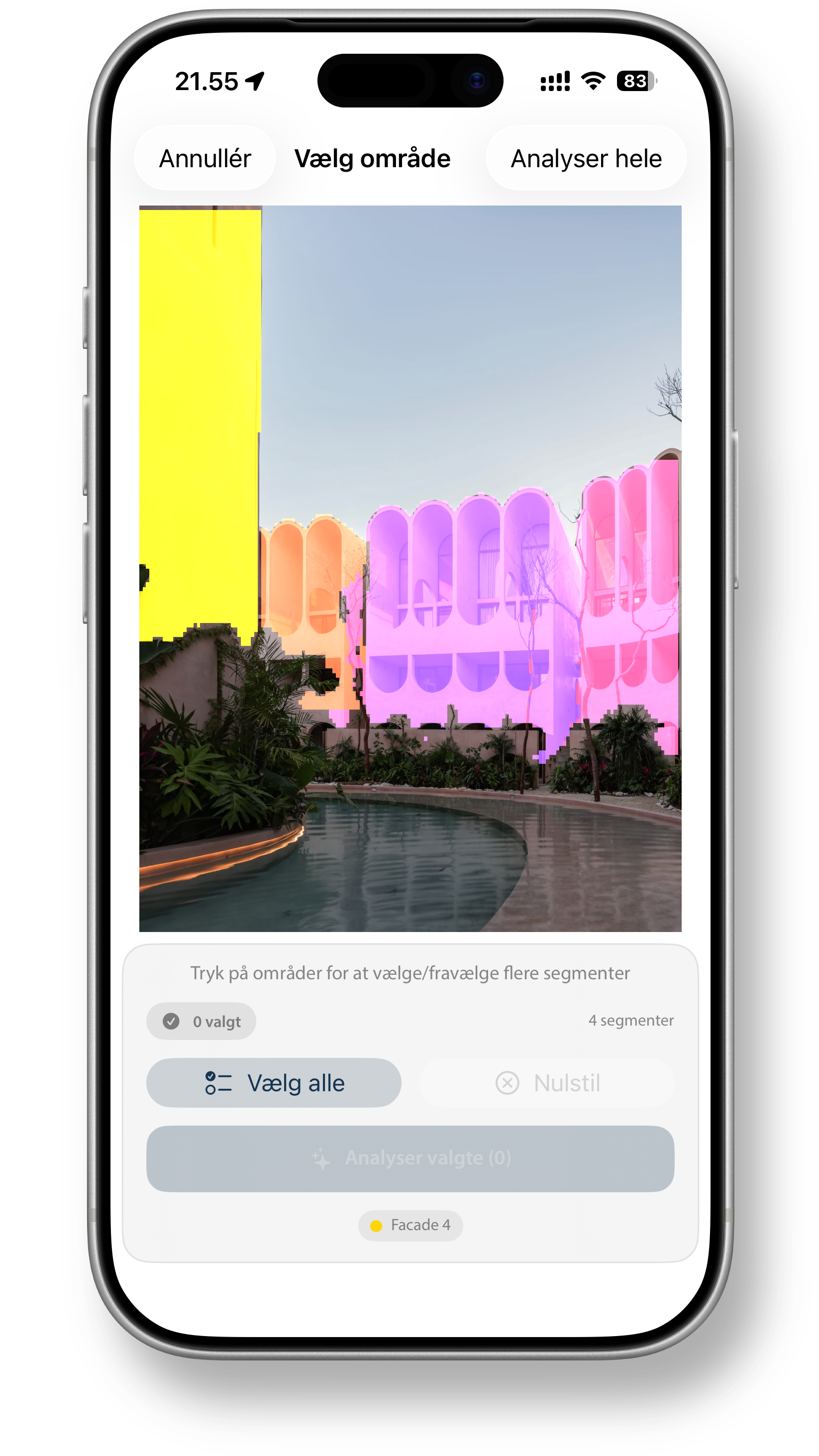
CoreML segmentation isolating the facade with colored overlays
OPERATION / 01
Point

Frame the facade. CoreML segmentation isolates the building surface from sky, vegetation, and street furniture.

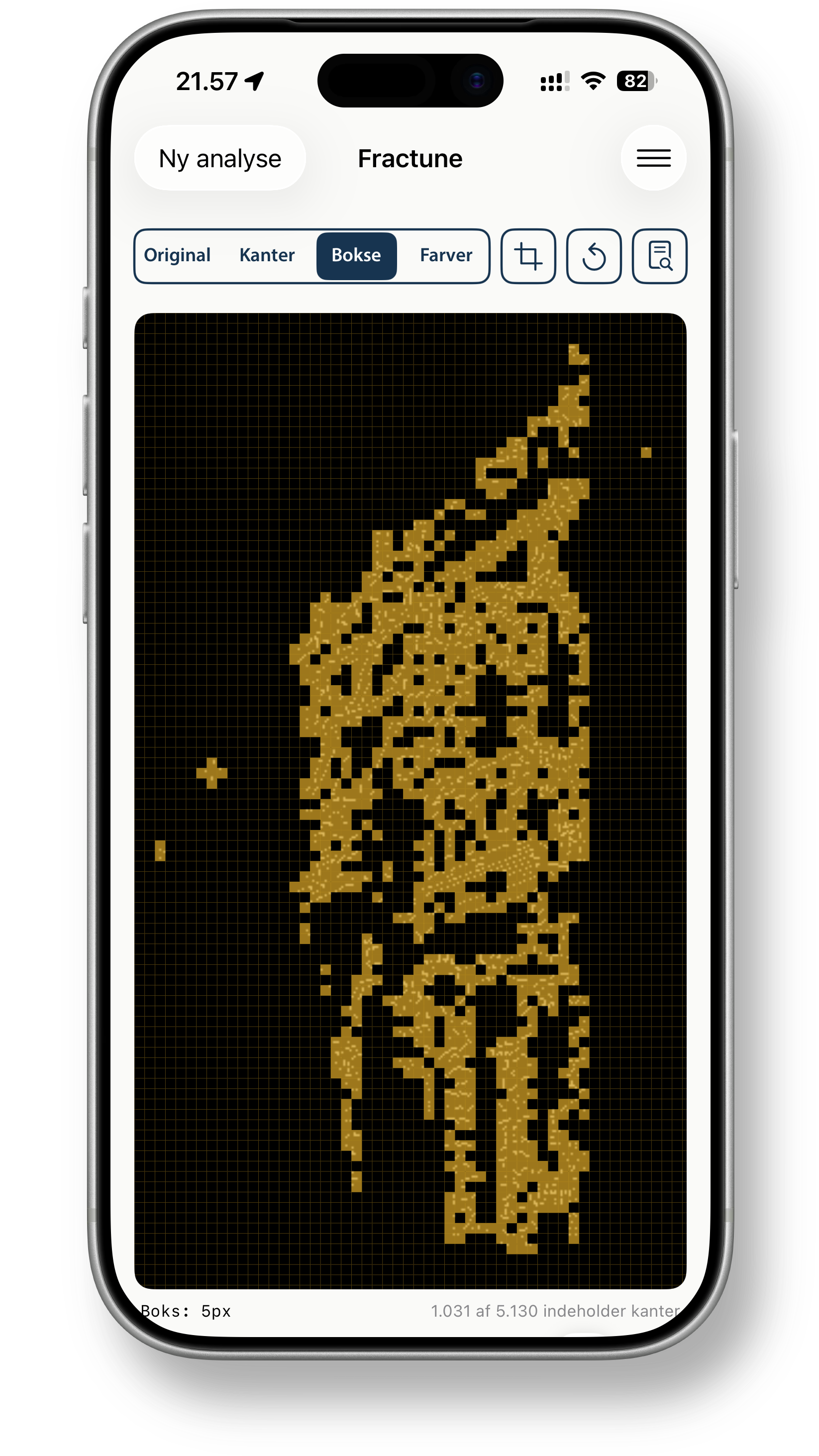
Box-counting visualization, gold boxes covering the facade edges
OPERATION / 02
Scan

Four parallel pipelines run on-device: fractal box-counting, FFT-based rhythm analysis, CIELAB colour clustering, and structural composition. F is composed from all four.

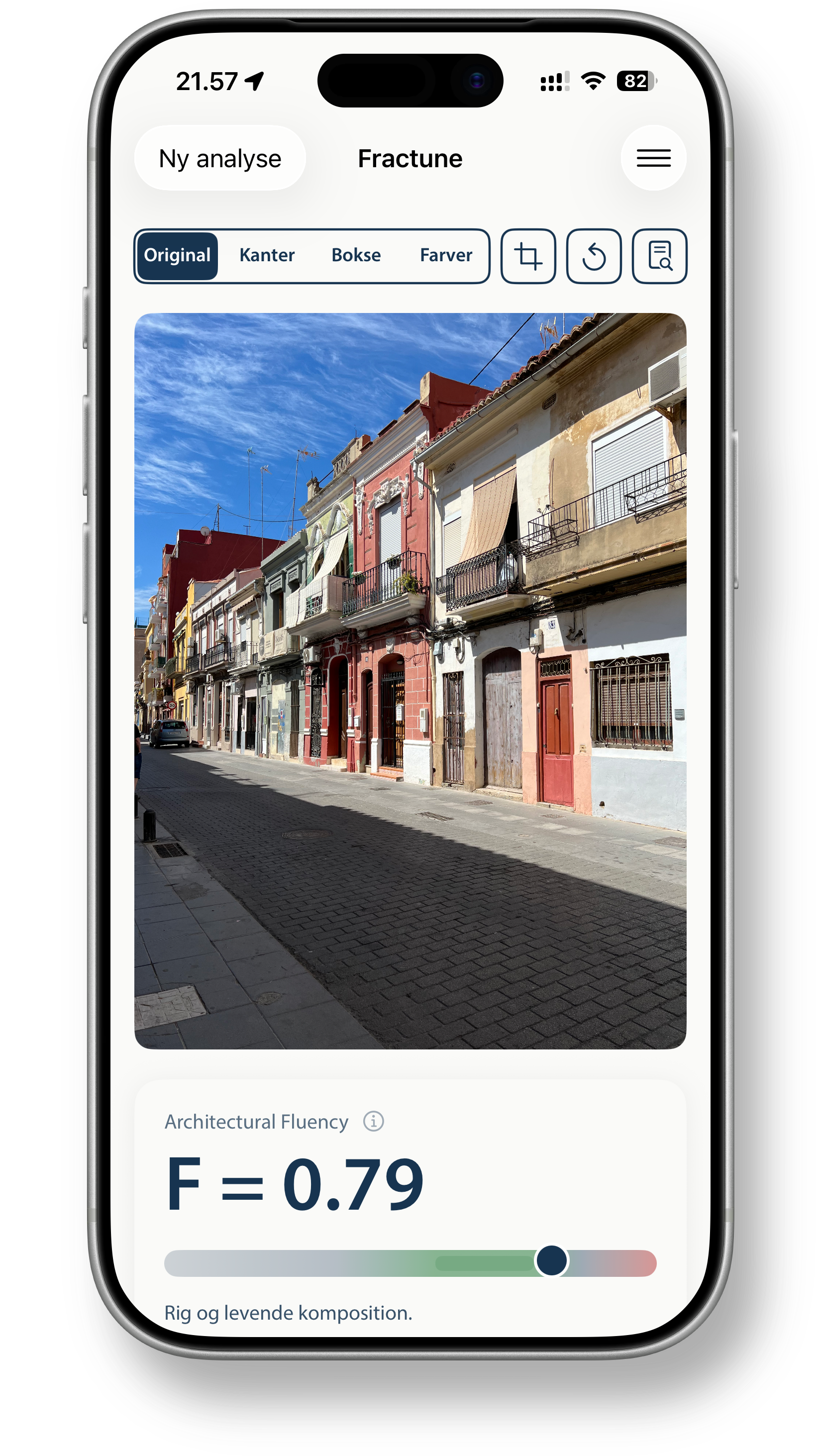
Result screen showing F with the sweet-spot bar and four dimension breakdown
OPERATION / 03
Understand

F lands on the sweet-spot bar with confidence indicator. Fold open each dimension to see its sub-metrics: D, Λ, Hθ, β, Rw, B, V, Σ_h, κ, Δ_L.

The instrument in full.

One measurement unfolds into seven parallel readings, geometry, rhythm, colour, structure, segmentation, history, and a calibrated uncertainty marker.

01 Architectural Fluency F A single composite score 0–1, calibrated to a sweet zone of 0.55–0.75. COMPOSITE
02 Four Dimensions Fractal, rhythm, colour, structure, each with its own sweet spot and breakdown. MULTI-DIM
03 CoreML Segmentation On-device isolation of the facade from sky, vegetation, and surroundings. COREML
04 Quality Confidence F shown with "?" when image quality or perspective skew reduces reliability, never silently mislead. UNCERTAIN
05 Session History Every measurement saved with thumbnail and metadata, exportable as CSV. LOCAL
06 Research Contribution Anonymised scans optionally feed the open architectural dataset. Per-field consent. OPT-IN
07 Home Screen Widget Your latest F + D + C, plus pending donation queue, refreshed at a glance. WIDGETKIT

Built on decades of research.

Box-counting methods in architecture date to Bovill (1996). Fractune extends the tradition with calibrated iPhone optics, on-device CoreML segmentation, FFT-based spectral rhythm analysis, and a four-dimensional composition framework drawing on Spehar, Stamps, Salingaros, Vartanian, and the Aarhus School-of-Architecture work on cognitive responses to space.

Read the full methodology →
SELECTED REFERENCES
Mandelbrot, B. (1982)
Bovill, C. (1996)
Stamps, A. E. (2000)
Spehar & Taylor (2003)
Salingaros, N. (2006)
Vartanian et al. (2013)
Ostwald & Vaughan (2016)
Stanischewski et al. (2020)
and 44 others →

Every reading lands
on a public map.

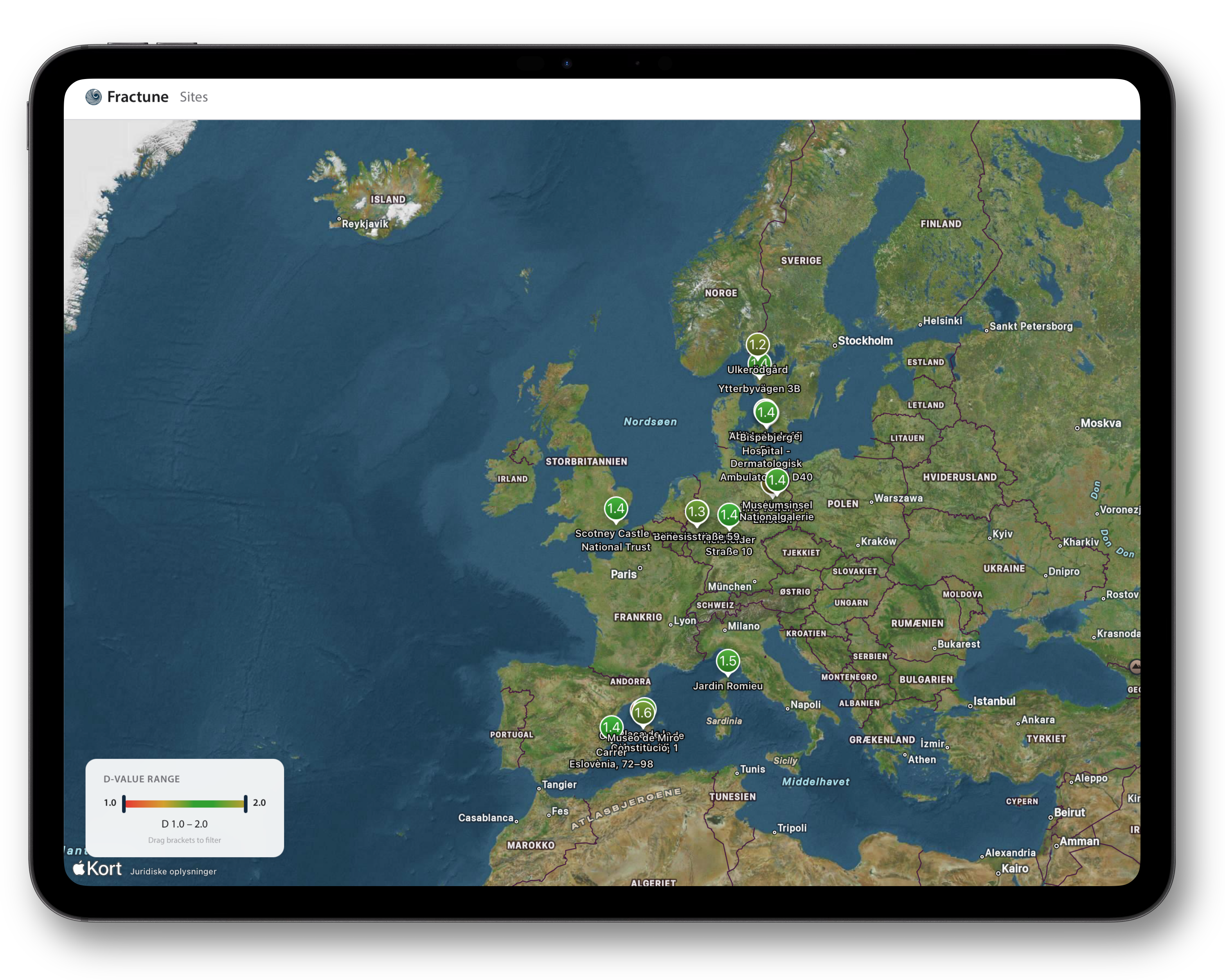
sites.fractune.dk is the browser-side companion to the app, a living atlas of anonymised facade readings. Filter by city, era, style, or F-band. Browse the sweet spot, hunt for outliers, compare your street to a Renaissance palazzo.

Browse
Every reading, mapped and searchable.
Compare
Stack any two facades side by side.
Filter
By city, century, style, or F-band.
Cite
Permalinks for every observation.
Visit sites.fractune.dk →
sites.fractune.dk showing analysed buildings on a satellite map of Europe
PL. 05 · sites.fractune.dk